Dr. Lazenby
Towards ZeroDr. Lazenby is the district’s police surgeon, a local doctor whose examinations and judgments become part of several crucial strands of the investigation. He assesses Mr. Treves’s fragile health, examines Lady Tressilian after her death, identifies how her maid was drugged, and supplies Battle with a bounded estimate of the time of death. His role is not that of the detective: the value of his evidence lies in what medical observation can establish, and in the limits it cannot remove.
Local Doctor and Police Surgeon
Dr. Lazenby first appears in connection with the local community around Mrs. Rogers’s establishment. Mrs. Rogers is speaking with a tall, middle-aged man when he raises a friendly hand to greet Mary Aldin. The greeting presents him as a familiar local figure before the scene establishes his professional standing. The group goes into the establishment’s small sitting-room, where he asks whether Mr. Treves had been dining there the previous night. His question turns an ordinary social encounter toward the circumstances of the older man’s death.
His medical work has both a local and an investigative dimension. He is the police surgeon for the district, a position that brings him to Lady Tressilian’s bedside when her body is found. That role gives his observations procedural weight, but the episodes also show that a medical opinion may remain qualified: he can assess a person’s condition, identify a route by which a drug was taken, and estimate a period of death without thereby settling every question of criminal responsibility.
Mr. Treves’s Health
In discussing Mr. Treves, Dr. Lazenby describes the death as consistent with the danger posed by serious heart conditions, in which the end may come suddenly. He has examined Mr. Treves’s prescriptions upstairs and judges his health to have been precarious. He also says that he will communicate with the patient’s doctor in London, extending the inquiry beyond his own local examination rather than treating his assessment as the last word.
The prescriptions matter because they give his conclusion a concrete medical basis in the account: Dr. Lazenby has looked at the treatment Mr. Treves was receiving, not simply inferred his condition from the fact of death. At the same time, he does not claim that the papers provide a complete history. His stated intention to consult the London doctor marks the distinction between an initial professional judgment and a fuller medical picture. The scene therefore supplies a plausible account of sudden death while keeping the investigation attentive to what further information may establish.
Lady Tressilian’s Household
After Lady Tressilian is found dead, Dr. Lazenby bends over her body in his capacity as police surgeon. His arrival is connected to the household’s response: he explains that the butler sent for him before the discovery of the maid in a coma. The sequence places him in the unfolding emergency, though it does not establish that he witnessed the events that produced either woman’s condition.
The maid’s condition leads him to distinguish between an assumed explanation and the evidence in the room. He rejects the suggestion that she had been given a sleeping draught, saying there is no sign of one there, and identifies the means by which the drug was administered: the maid drank a brew of senna pods every night, and the substance was in that preparation. The regularity of the nightly drink is significant. It offered a familiar, routine vehicle for the drug, so the method did not depend on introducing an obviously unusual drink into the household. Dr. Lazenby’s finding explains how the maid could have been drugged while also showing why the usual household habit mattered to the case.
Evidence and the Time of Death
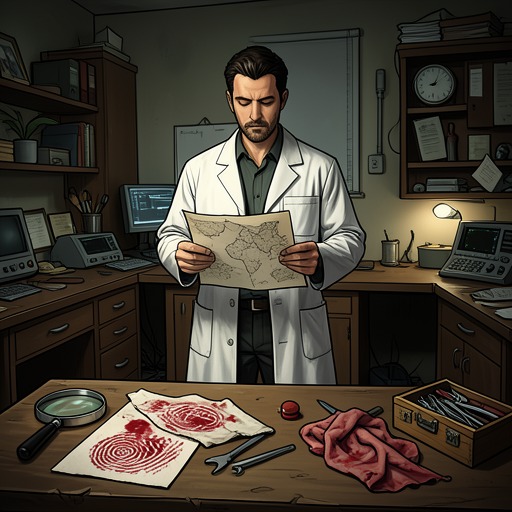
The investigators’ discussion of the bloodied niblick records an important limit to Dr. Lazenby’s medical judgment. They say that he did not favor the weapon as the explanation, but had accepted it because it was the obvious candidate and he could not state definitively that it had not been used. This is not a positive identification of the weapon. His uncertainty leaves room for the possibility that the apparent evidence has been staged, while making clear that medical examination alone has not conclusively disproved the niblick’s use. The distinction between an object that looks persuasive and one medically established as the instrument of death is central to how the investigation reassesses the scene.
Battle later returns to Dr. Lazenby’s house to ask when Lady Tressilian died. Dr. Lazenby places the time in the neighborhood of eleven o’clock and agrees that it could not have been later than midnight. His estimate gives Battle a time boundary against which to test the accounts and movements of the people involved. It remains an estimate rather than an exact recorded moment, but the upper limit is useful precisely because it can narrow the possible sequence of events.
Across these episodes, Dr. Lazenby contributes several distinct kinds of evidence: the precarious state of Mr. Treves’s health, the ordinary drink used to drug the maid, a cautious position on the supposed murder weapon, and a time range for Lady Tressilian’s death. The force of his part in the story comes from that combination of expertise and restraint. He helps clarify what the bodies, prescriptions, and household routines can support, while leaving the investigators to confront what those facts do not settle by themselves.